Marshall Gold Discovery Park: Sutter’s Mill, the Accidental Gold Strike, and the Boom That Built California
The Secret That Shook the World
Marshall and his business partner, Swiss pioneer John Augustus Sutter, tried desperately to keep the discovery quiet. Sutter was constructing an agricultural and timber empire based out of Sutter’s Fort in Sacramento; he knew that if word of gold got out, his laborers would abandon his crops, squatters would overrun his livestock pastures, and his sawmill would sit abandoned.
Their secret lasted barely a few weeks. By May 1848, an enterprising San Francisco merchant named Samuel Brannan walked through the muddy streets of Portsmouth Square holding aloft a quinine bottle filled with sparkling gold dust from Coloma, shouting: "Gold! Gold! Gold from the American River!" Brannan had quietly bought up every shovel, pickaxe, iron pan, and bucket in the Bay Area before shouting the news, becoming California’s very first Gold Rush millionaire without ever digging an ounce of dirt himself.
By late 1848, President James K. Polk confirmed the richness of the California gold deposits in his State of the Union address, and the world lost its mind. In 1849 alone, more than 90,000 fortune hunters—the legendary "forty-niners"—flooded into California from across the United States, Chile, Mexico, China, Australia, and Europe. Coloma, which had been a quiet Nisenan village called Culloma, ballooned overnight into a chaotic boomtown of thousands with dozens of saloons, tent hotels, gambling halls, and general stores.
The Tragic Irony of Marshall and Sutter
The great historical tragedy of Coloma is that neither of the two men who sparked the Gold Rush profited from it. John Sutter's vast ranch lands were overrun, his cattle stolen, and his lumber mill dismantled for scrap by frenzied prospectors. He spent his final decades in Washington, D.C., fruitlessly lobbying Congress for financial restitution before dying in 1880 in Pennsylvania.
James Marshall fared even worse. Prospectors hounded him constantly, believing he had supernatural clairvoyance to locate rich veins. Disillusioned, Marshall attempted wine growing and small-scale mining in the nearby hamlet of Kelsey. He died alone in 1885 in a crude eight-by-ten wooden shack, impoverished and virtually penniless.
In 1890, the State of California erected its very first state historic monument in Marshall’s honor: a towering bronze statue of the carpenter standing atop a granite pedestal high on the hill above Coloma, his arm outstretched, pointing his finger eternally downward toward the exact bend in the American River where he spotted the gold. Beneath that monument, Marshall’s remains rest today.
While the park has plenty of parking, California State Parks docents enforce a strict heat safety policy: when summer temperatures in the Coloma canyon exceed 92°F to 95°F, outdoor guided tours and working demonstrations at the sawmill are suspended for public safety. Arrive by 9:00 AM to catch the morning tours and hike the Monroe Ridge Trail before midday foothill heat sets in.
What to See: The Living Town of Coloma
Roughly 70 percent of historic Coloma is enclosed within park boundaries, making it one of the most intact outdoor Gold Rush historic landscapes in the state:
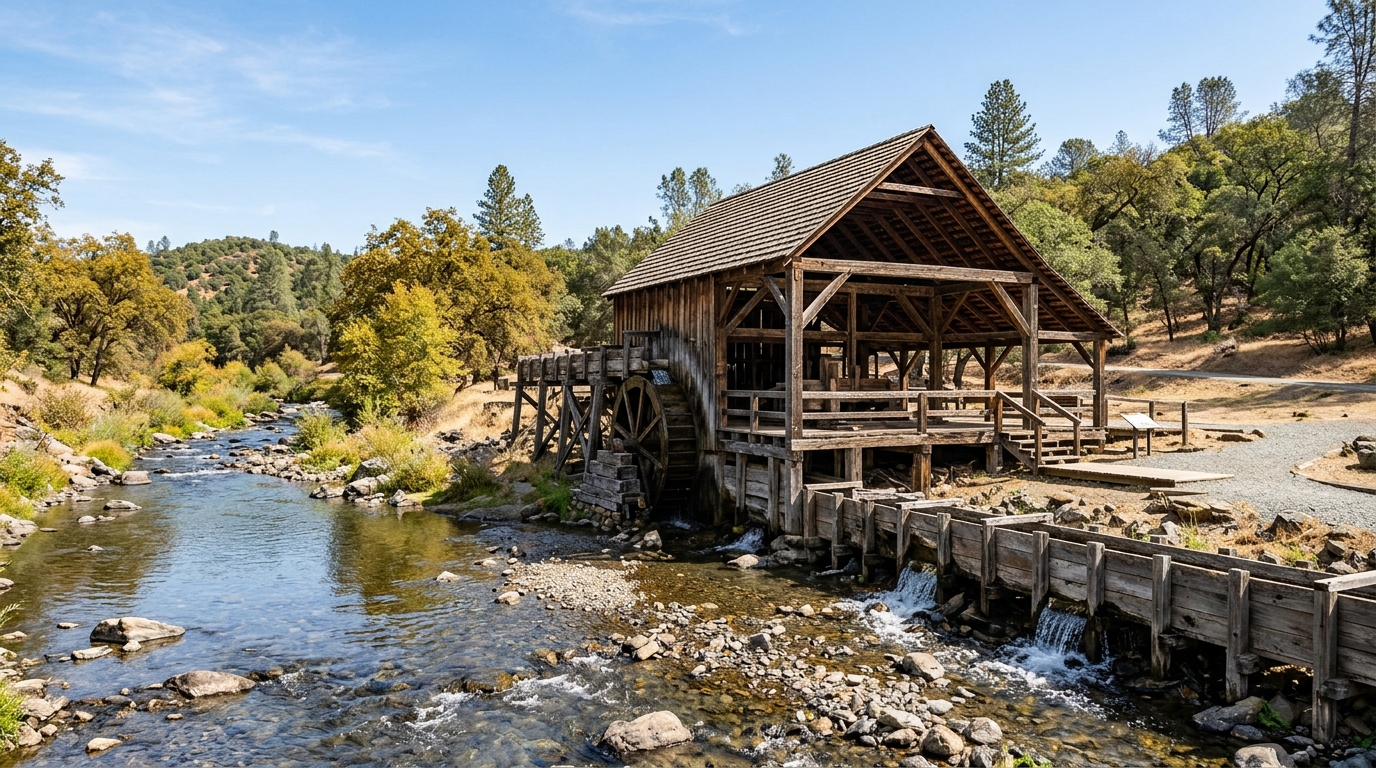
- The Reconstructed Sutter’s Mill: Built in the late 1960s using 19th-century timber joinery techniques, this working replica features an operational water wheel and vertical pit saw blade. During living history events, park rangers channel river water through the millrace to demonstrate how timber was cut in the 1840s.
- The Gold Discovery Museum: Featuring original 1840s mining implements, scale models of early river mining, authentic Native American Nisenan basketry, and interpretive exhibits on the diverse miners—including African American, Chinese, and Hawaiian prospectors—who worked the foothill placers.
- Historic Wah Hop & Man Lee Stores: Built of durable local granite and schist brick in the 1850s, these surviving Chinese merchant houses served Coloma’s thriving Chinese mining community when anti-immigrant taxes and mining codes pushed them out of mainstream claims.
- Gold Panning Demonstrations: Try your own hand at panning for authentic foothill gold flakes, garnets, and pyrite in the park’s supervised demonstration troughs under the guidance of seasoned docents.
Hiking Trails: Monroe Ridge and the Monument Loop
Beyond the historic storefronts, Marshall Gold Discovery features scenic hiking trails weaving through the oak and pine foothill canopy:
- Monroe Ridge Trail (2.4 miles round trip): Beginning near the North Beach picnic area, this moderate trail climbs the ridge overlooking the American River valley, passing remnants of 1850s ditch networks and ancient oak groves, before descending to the James Marshall Monument.
- Monument Loop (0.8 miles): A short, paved trail winding from Church Street up the grassy hillside to the Marshall Monument and Marshall’s restored 1850s bachelor cabin.
Actionable Logistics: Visiting Coloma
Everything you need to plan a visit to Marshall Gold Discovery State Historic Park:
- Location & Hours: Located along Highway 49 in Coloma (310 Back Street). The park grounds are open daily from 8:00 AM to sunset. The Museum and Visitor Center are open 10:00 AM to 4:00 PM.
- Parking Fee: $10 per passenger vehicle ($9 for seniors 62+). California State Parks annual vehicle day-use passes are accepted.
- Guided Tours: Walking tours of the historic district are offered daily (weather permitting) for $3 per adult and $2 per child. Sign up at the museum desk upon arrival.
- River Safety: The South Fork of the American River has strong, cold currents fed by upstream hydroelectric dams. While wading is permitted in designated calm shallows, always wear life jackets and keep a close eye on children.


Comments
Post a Comment