Historic Placerville & Gold Bug Mine: Hardrock Drifts, Stamp Mills, and the True Lore of Hangtown
The Great Shift: From Placer Gravels to Hardrock Veins
The opening chapter of the California Gold Rush was fought on the surface. Between 1848 and the late 1850s, amateur prospectors armed with simple tin pans, rocker boxes, and Long Toms scraped hundreds of millions of dollars in loose "placer" gold from the American River and its tributary creeks. But by the late 1880s, the easy gravel deposits were exhausted.
To survive, California miners had to evolve into subterranean hard-rock geologists. Gold in the Sierra Nevada foothills had not originated in riverbeds; it had been injected into vertical quartz fissures deep within ancient metamorphic slate during tectonic convulsions over 140 million years ago. Getting to that gold required dynamite, pneumatic drills, heavy timbering, and mechanical stamp mills.
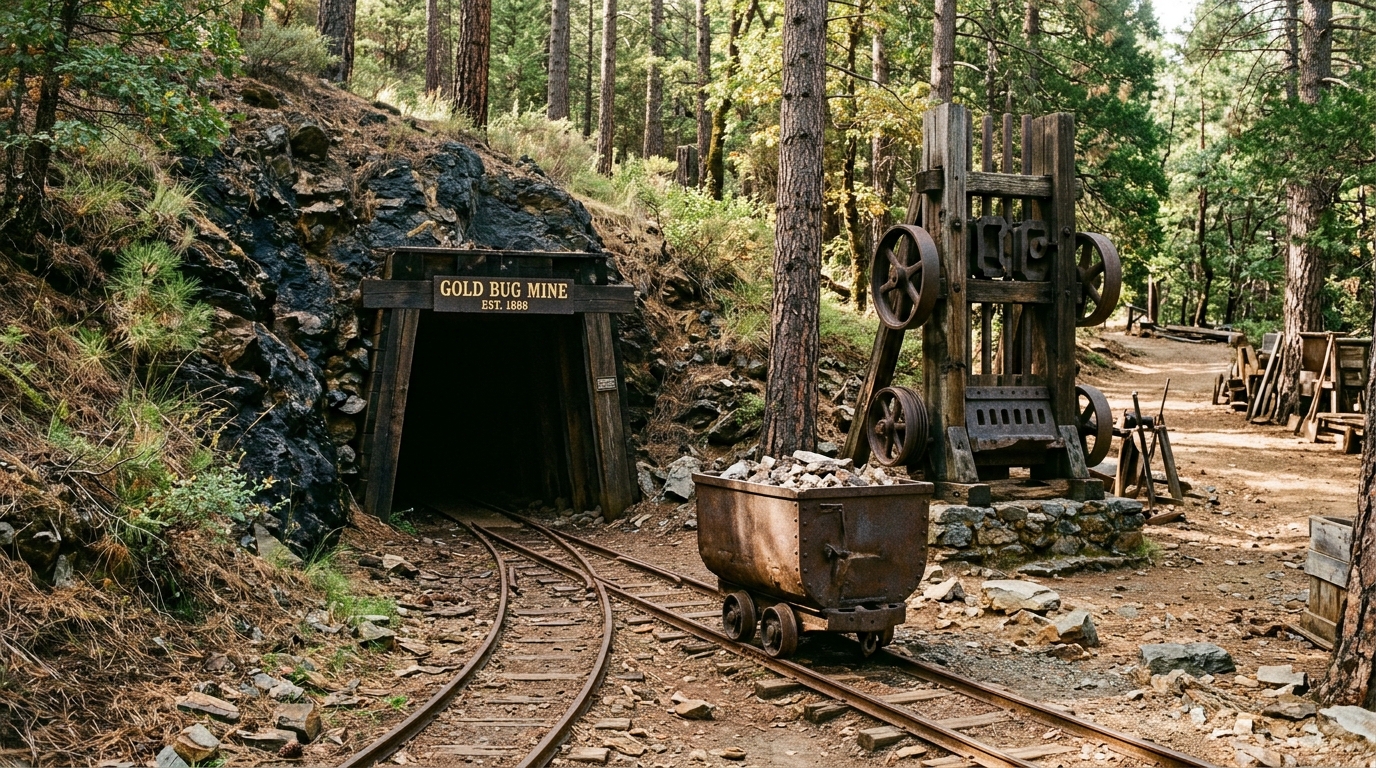
In 1888, a determined miner named William Meagher staked his claim on the hillside above Big Canyon, filing patents on what was initially named the Hattie Mine (later renamed the Gold Bug). Unlike the gargantuan Empire Mine in Grass Valley, which sank vertical elevator shafts miles into boiling subterranean heat, Meagher drove a horizontal drift mine (or adit) 352 feet straight into the cool hillside, chasing a promising ribbon of gold-bearing white quartz.
Inside the Drift: Cold Stone and Hand-Steel Labor
Walking through the timber-framed portal of Gold Bug Mine today immediately drops the ambient temperature to a crisp, permanent 54°F (12°C). Water trickles constantly down the fractured granite walls, pooling in narrow ditches alongside narrow-gauge iron tracks that once carried wooden ore cars to the daylight.
The mine is remarkably intact. Donning a hardhat and taking the self-guided audio tour, visitors can inspect the jagged marks left by single-jack and double-jack hand steeling:
- Single-Jack Drilling: A solitary miner held a cold chisel in one hand and swung a four-pound sledge with the other, striking the steel, turning it a quarter-turn, and striking again—drilling holes by hand into solid quartz inch by agonizing inch.
- Double-Jack Drilling: A two-man team where one man gripped the heavy drill steel between his knees while his partner swung an eight-pound sledgehammer within inches of his fingers. A misplaced blow meant shattered bones; a clean strike meant four feet of borehole drilled in an hour, ready to be packed with black powder or nitroglycerin dynamite.
- The White Quartz Vein: Deep within the 352-foot drift, the ceiling exposes the pristine white ribbon of the Mother Lode quartz vein, flecked with iron pyrite ("fool's gold") and telltale mineral stains.
Don't leave the park after touring the Gold Bug drift. Walk 200 yards up the canyon trail to the Priest Mine. Driven in the early 1900s by a local Episcopal minister, the Priest drift penetrates 130 feet into the rock and features an unlined, raw stone interior without electric lighting. Bring a strong handheld flashlight to inspect the undisturbed timber supports and mineral crystal formations.
The Thundering Heart: The Joshua Hendy Stamp Mill
Blasting quartz rock out of the mountain was only half the battle. Because the gold particles inside hard-rock ore were often microscopic, the quartz had to be pulverized into fine flour before the precious metal could be extracted through mercury amalgamation.
Gold Bug Park houses one of the finest working restorations of a historic Joshua Hendy Stamp Mill in California. Founded in San Francisco during the Gold Rush, the Joshua Hendy Machine Works built the heavy industrial equipment that powered mining operations across North America.
Inside the mill building, a massive overhead camshaft lifts eight-foot-tall iron stampers weighing 1,500 pounds each, dropping them onto heavy cast-iron dies inside the mortar battery over 100 times every minute. In the 1890s, the deafening, rhythmic roar of stamp mills echoing through Big Canyon was the pulse of Placerville’s economic life—a sound that signaled ore was crushing and paydays were coming.
Hangtown Lore: Studebaker, Mark Hopkins, and the Hangtown Fry
Visiting Placerville connects modern travelers with legends whose fortunes began long before they became household names:
- John Mohler Studebaker: Arriving in Hangtown in 1853 with just a single dollar, young John Studebaker recognized that miners desperately needed rugged wheelbarrows that wouldn't shatter under rock loads. He went to work for blacksmith Joe Dismont, manufacturing over 2,000 wheelbarrows branded "J.M. Studebaker" at $10 each. He took his $8,000 savings back to South Bend, Indiana, to invest in his brothers' wagon company—which ultimately grew into the Studebaker automobile empire.
- Mark Hopkins: Before becoming one of the "Big Four" railroad barons who financed and built the Central Pacific transcontinental railroad, Hopkins operated a humble wholesale grocery and supply store on Placerville’s Main Street.
- The Hangtown Fry: Local culinary lore tells of a prospector who struck it rich at Gold Bug, marched into the El Dorado Hotel saloon, and demanded the most expensive meal the house could produce. The cook whipped together the three costliest ingredients available on the frontier: fresh eggs, bacon, and Pacific oysters packed in ice by stagecoach from San Francisco. The legendary Hangtown Fry remains on local menus to this day.
Visitor Logistics and Planning Your Visit
Visitor Essentials & Park Access
- Address: 2635 Gold Bug Lane, Placerville, CA 95667 (1 mile north of Highway 50 via Bedford Avenue).
- Operating Hours:
- April through October: Open daily, 10:00 AM – 4:00 PM.
- November through March: Open weekends only, 10:00 AM – 3:00 PM (weather permitting). The park grounds and hiking trails remain open sunrise to sunset year-round.
- Admission & Tours: Self-guided audio tour of Gold Bug Mine (includes hardhat and audio wand) is $12 for adults (ages 18–61), $10 for seniors/military, $6 for youth (ages 4–17), and free for children 3 and under. Entry to the 60-acre park grounds, picnic sites, and walking trails is free.
- Amenities: The park features Hattie’s Gift Shop & Museum, an operating historical Blacksmith Shop, the historic Meagher House, the Cornwall Mineral Collection, and shaded picnic groves along Big Canyon Creek.
- What to Wear: The underground mine maintains a constant 54°F temperature with occasional damp walkways. A light jacket and closed-toe walking shoes with good tread are strongly recommended.


Comments
Post a Comment