Calaveras Big Trees: Mammoth Sequoias, Discovery Stumps, and the Birth of California Conservation
The Tragic Felling of the "Discovery Tree"
Word of Dowd’s giant trees spread across California like wildfire. But in the predatory, boom-or-bust atmosphere of the Gold Rush, wonder quickly curdled into commercial greed. Eastern audiences and European scientific societies refused to believe that living organisms of such staggering mass existed on Earth, dismissing newspaper reports as typical frontier humbug and California exaggeration.
To prove the existence of the giants and turn a handsome profit, speculative promoters decided to fell the largest, most magnificent tree in the North Grove: the Discovery Tree. Over three hundred feet tall and more than twelve hundred years old, the behemoth proved nearly impossible to cut down. No crosscut saw in North America was long enough to span its 25-foot diameter.
In the summer of 1853, five men labored for twenty-two grueling days using hand-pumped mechanical augers, boring hundreds of parallel holes through the trunk and hammering in giant iron wedges until the monarch finally groaned, broke, and crashed to the forest floor with a sound that shook the earth for miles.
Sections of its thick bark and cross-sections of the trunk were painstakingly numbered, packed onto mules, shipped down the mountains to Stockton, and sent around Cape Horn to New York and London to be reassembled in exhibition halls. Even with the physical bark on display, skeptical crowds in Manhattan sneered that it was an elaborate circus hoax constructed from glued redwood planks. The exhibition failed financially, and the historic pieces were eventually destroyed in warehouse fires.
"The Vandals Danced Upon the Stump"
Back in Calaveras, the indignity inflicted upon the fallen giant only deepened. The massive 25-foot stump left behind was planed smooth, varnished, and converted into an outdoor dance pavilion. A temporary wooden arbor was built over it, hosting cotillions, theatrical performances, a makeshift saloon, and even a two-lane bowling alley laid out along the recumbent fallen trunk.
The desecration did not end there. In 1854, another group of promoters attacked the Mother of the Forest, a 328-foot sequoia that was the tallest tree in the grove. Workers erected over one hundred feet of wooden scaffolding up its living trunk and systematically stripped sixty tons of its thick, fibrous bark to exhibit at the Crystal Palace in London. Stripped of its fireproof insulating bark and vital vascular cambium, the mutilated tree died. It was further gutted by a forest fire in 1908, leaving behind the blackened, soaring hollow snag that still stands on the trail today.
The wanton destruction of these ancient monarchs ignited a furious moral backlash among early American intellectuals:
- John Muir’s Fury: When the legendary naturalist visited the grove, he was sickened by what he saw, penning one of the most blistering broadsides in conservation history: "Then the vandals danced upon the stump! But some yet live to remind us of the glorious forest that was, and to tell us what a noble thing nature can make when left alone."
- The Spark of American Conservation: Outrage over the Calaveras trees reverberated all the way to Washington, D.C. In 1864, California Senator John Conness cited the horrific destruction of the Calaveras sequoias when introducing the Yosemite Grant, signed by President Abraham Lincoln, which set aside public lands for preservation for the first time in world history.
From Frontier Exploitation to State Park Sanctuary
Although public outcry halted further felling, the Calaveras Grove remained in private logging hands for nearly eight decades. Lumber barons repeatedly threatened to clear-cut the surrounding sugar pine and sequoia stands for commercial timber.
In 1926, passionate citizens organized the Calaveras Big Trees Association, launching an impassioned nationwide fundraising campaign to buy the land. Partnering with the Save the Redwoods League and the newly formed California State Parks Commission, they finally secured the North Grove in 1931, creating Calaveras Big Trees State Park. In 1954, the state acquired the much larger, pristine South Grove, permanently safeguarding over one thousand mature giant sequoias.
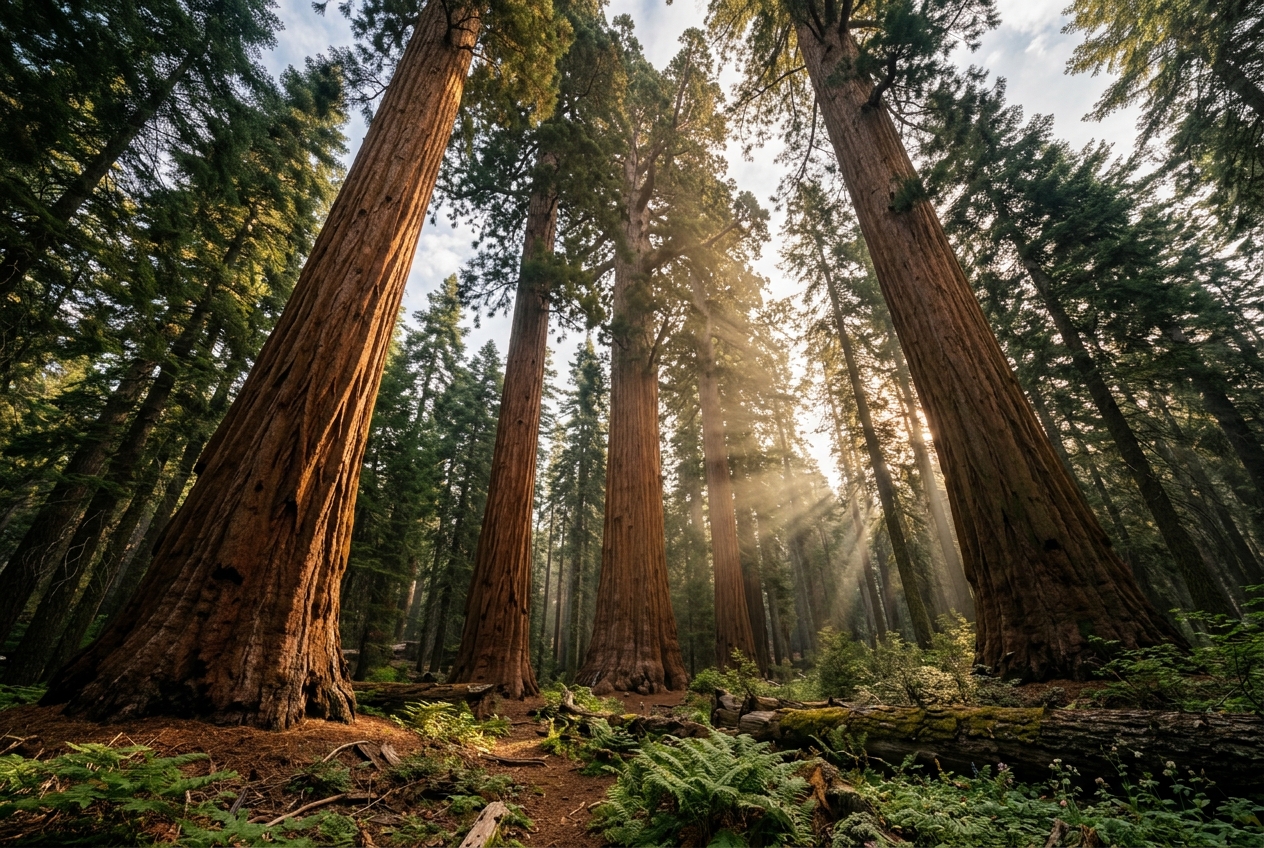
While 90% of park visitors only walk the popular 1.5-mile North Grove loop, the true magic of Calaveras lies in the South Grove Natural Preserve. Located an 8-mile scenic drive past the park entrance along Walter W. Smith Parkway, the South Grove is home to ten times more mature sequoias and virtually zero crowds. The 5-mile round-trip loop takes you through untamed old-growth wilderness to the Agassiz Tree, one of the ten largest living trees on Earth.
Hiking the Groves: North vs. South
Exploring Calaveras Big Trees offers two remarkably distinct experiences depending on your time and hiking appetite:
- The North Grove Trail (1.5-mile loop): Level, accessible, and well-graded, this self-guided interpretive loop winds past the historic Discovery Tree stump (where a wooden staircase allows you to stand atop the giant), the charred shell of the Mother of the Forest, the Pioneer Cabin tree ruins, and the historic 1850s Big Trees Hotel site.
- The South Grove Trail (5 miles round-trip): A moderately graded backcountry trek following Beaver Creek into a secluded wilderness basin. Here, hundreds of towering sequoias grow among ancient sugar pines, white firs, and dogwoods that erupt into brilliant pink and cream blossoms in May and blazing gold in October.
- Stanislaus River & Beaver Creek: In summer, cool off in the crystal-clear granite pools of the North Fork Stanislaus River at the park's scenic picnic day-use area.
Actionable Logistics: Planning Your Visit
Calaveras Big Trees State Park sits along Highway 4 in the Sierra foothills, four miles northeast of Arnold at an elevation of 4,700 feet:
- Operating Hours & Seasons: Open sunrise to sunset 365 days a year. The Visitor Center and Museum operate daily from 10:00 AM to 4:00 PM. Note that the road to the South Grove closes to vehicle traffic after the first major winter snowfall (usually November to April), but the North Grove remains open for snowshoeing and cross-country skiing.
- Park Admission: $10 per vehicle day-use fee (payable at the entrance kiosk or via California State Parks Golden Poppy passes).
- Camping & Lodging: The park features two developed campgrounds (North Grove and Oak Hollow) with 120 shaded campsites, hot showers, and campfire rings, reservable through ReserveCalifornia. Alternatively, stay in historic Gold Rush inns in nearby Murphys.
- What to Pack: High elevation means rapid temperature shifts; layer clothing even in summer. Sturdy walking shoes, plenty of drinking water, and insect repellent are essential for the South Grove trail.


Comments
Post a Comment