Queen of the Southern Mines: Gold, Conflict, and the Enduring Legacy of Sonora, California
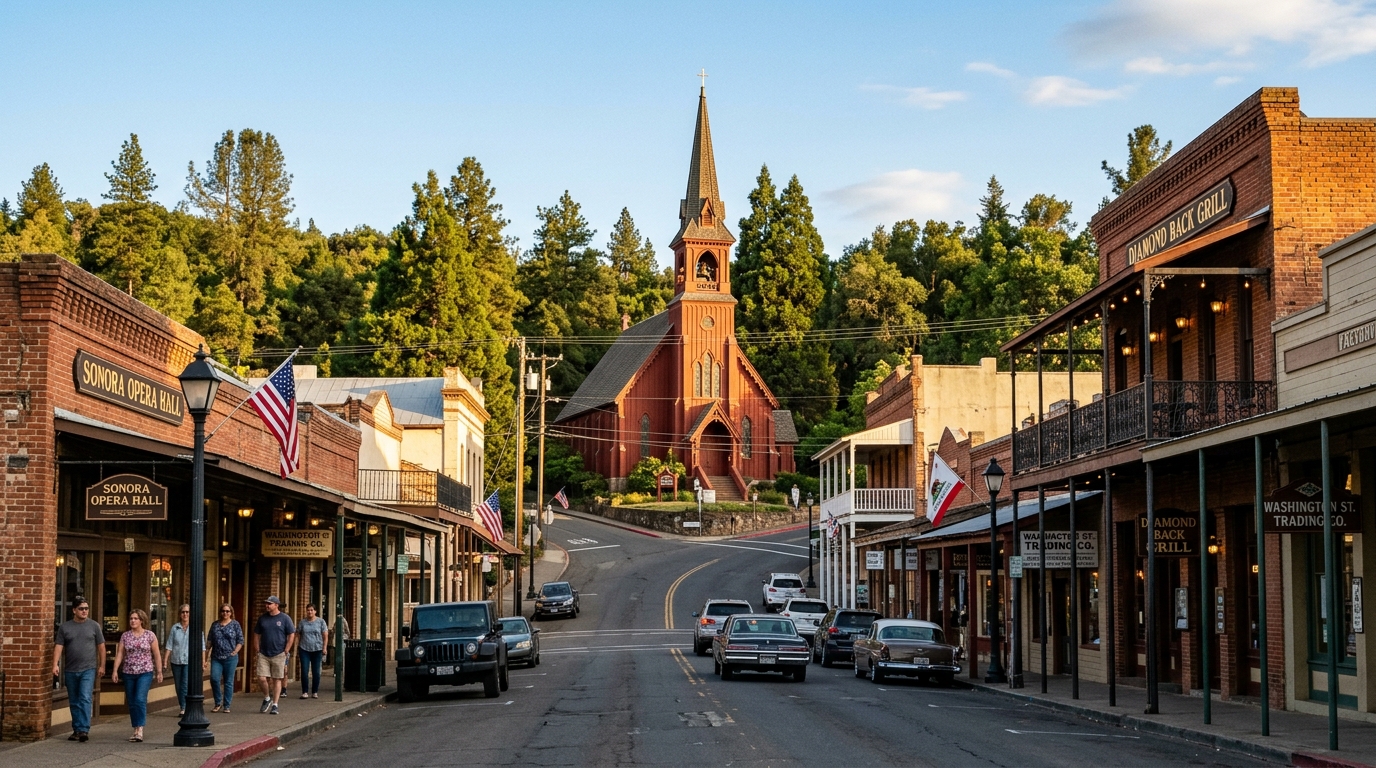

Featured Image

Part I: The Sonoran Foundation and the Global Rush (1848-1850)

In the annals of the American West, the story of the typical Gold Rush town is usually a tale of Anglo-American discovery and conquest. Sonora, California, however, stands as a fascinating exception. Its origins are not rooted in the eastward expansion of the United States, but rather in the northward migration of experienced Mexican miners. Their expertise, rich culture, and even their name defined the settlement long before the iconic wave of "forty-niners" arrived. The city that would eventually be crowned the "Queen of the Southern Mines" was born not as an American camp, but as a distinctively Sonoran one.

The Arrival of the Sonorans

In the summer of 1848—mere months after James Marshall's historic discovery at Sutter's Mill—a group of miners from the Mexican state of Sonora established a camp in the lucrative placer fields of the Sierra foothills. These were not novice prospectors chasing feverish dreams of easy wealth; many were seasoned professionals and discharged veterans of the Mexican-American War, collectively known as Sonoranians. They brought sophisticated mining techniques honed in the silver and gold mines of their homeland. Among these innovations was the arrastra, an animal-driven mill used to pulverize quartz ore and release fine gold particles. This method was vastly superior to the simple panning techniques used by early American arrivals. Logically, they named their settlement Sonoran Camp, and the area quickly proved immensely profitable. Contemporary reports boasted of astonishing yields; one legendary account tells of three Frenchmen extracting three and a half pounds of gold in less than three hours.

The Global Influx

Word of these extraordinary riches traveled with breathtaking speed. Interestingly, the first waves of fortune-seekers did not hail from the East Coast of the United States. Instead, they arrived from lands connected to California via the Pacific sea lanes. Throughout the summer and fall of 1848, thousands journeyed from Oregon, Hawaii, Mexico, Peru, and Chile, descending upon the goldfields months before most Americans even knew of the discovery. It wasn't until President James K. Polk formally confirmed the vast gold deposits in his State of the Union address on December 5, 1848, that the floodgates truly opened.

The ensuing migration remains one of the largest in American history. The "forty-niners," as they were later dubbed, endured grueling journeys. Many boarded ships on the East Coast, sailed to Panama, traversed the treacherous Isthmus on foot or horseback, and then fought for passage on overcrowded vessels bound for San Francisco. From there, it required a two-day schooner trip to Stockton, followed by a punishing, dust-choked stagecoach ride into the foothills. Arriving in Sonoran Camp, travelers found a primitive settlement defined by dirt streets, canvas tents, and scarce accommodations.

A Cosmopolitan Melting Pot

By the fall of 1849, the camp's population had surged to approximately 5,000—a figure it remarkably maintains to this day. The surrounding district housed an estimated 10,000 Mexican miners alongside 4,000 American and European prospectors. This made Sonora uniquely cosmopolitan compared to other mining camps. It was a chaotic, vibrant melting pot of Yankees, Mexicans, French, Germans, Spaniards, Chinese, Irish, and Chileans. This eclectic mix of humanity was mirrored in the settlement's architecture, which seamlessly blended French and Mexican styles. High-peaked roofs, external staircases, and colorful corridors stood in stark contrast to the utilitarian structures typical of Anglo-dominated camps.

The First Civic Act: A Response to Crisis

Life in this burgeoning camp was undeniably precarious. During the harsh winter of 1848-1849, a deadly scurvy epidemic swept through the settlement, fueled by poor nutrition and unsanitary living conditions. Remarkably, it was this shared public health crisis—rather than a desire for law and order or commerce—that spurred Sonora's first act of organized civic governance. On November 7, 1849, well before the town's formal incorporation, citizens convened to establish a hospital for the sick. Funded by benevolent contributions and the sale of town lots, the hospital helped curb the epidemic using lime juice and fresh potatoes, which provided the vital vitamin C the miners desperately needed. This foundational moment reveals a profound truth about Sonora: its initial social contract was rooted in a collective recognition of mutual vulnerability and the fundamental need for community care. This crucial act of public health preceded the establishment of a formal government, which eventually took shape when Sonora was incorporated as California's tenth city on May 1, 1851.

Part II: An Unflinching Account of the Gold Rush Conflict

The heavily romanticized image of the California Gold Rush—often filled with tales of plucky prospectors and overnight fortunes—masks a much darker, more violent reality. In Sonora, the pursuit of gold was inextricably linked to systemic racism, state-sanctioned violence, and brutal frontier justice. The town's cosmopolitan character, once a source of immense vitality, rapidly became a flashpoint for conflict. As Anglo-American miners flooded the region, they brought a fervent belief in their own racial and national superiority, transforming a cooperative environment into a violent struggle for control over the region's immense wealth.

Legislated Racism: The Foreign Miners' Tax of 1850

In April 1850, the newly formed California State Legislature passed the Foreign Miners' Tax, a law that codified the growing xenophobia within the goldfields. The act mandated that all non-U.S. citizen miners pay a prohibitive tax of $20 per month—equivalent to over $700 today. The primary intent was not to raise revenue, but to eliminate competition. It stemmed from a widespread, racist conviction among white miners that "only Americans had the God-given right to mine for gold." Although ostensibly applicable to all foreigners, the tax was disproportionately enforced against skilled Latino and Chinese miners, while European immigrants were frequently granted exemptions.

Sonora, with its large and prosperous population of Mexican, Chilean, French, and German miners, became the epicenter of the ensuing controversy. When tax collectors arrived, they faced widespread, fierce resistance. The result was a tragic period of intense violence throughout May and June of 1850. Assaults became daily occurrences, plunging the community into a state of "dread and terror" where residents dared not walk the streets unarmed.

The economic and social fallout was immediate and catastrophic. Faced with exorbitant fees and constant threats, the vast majority of foreign miners fled. Nearly two thousand inhabitants, including most of the founding Sonoran population, abandoned the town. Sonora's population was slashed in half, triggering the collapse of the local economy. Businesses shuttered, and the once-booming camp devolved into a "rather quiet place." Some miners, forcibly driven from their rightful claims, resorted to banditry, forming outlaw gangs that raided and retaliated against the American miners who had expelled them. This economic self-sabotage was so thorough that the State Legislature, admitting a "grave error," repealed the tax on March 14, 1851. While the repeal curbed the organized violence, Sonora's demographic and social fabric had been irrevocably damaged.

Genocide of the Miwok People

The land yielding this unimaginable wealth was far from empty. For centuries, the region around Sonora had been the ancestral home of the Miwok people, who maintained complex societies, bustling villages, and deep cultural ties to the land. The influx of hundreds of thousands of gold-seekers was not a peaceful settlement; it was an invasion that precipitated a devastating genocide.

This tragedy was not an unintended consequence. The destruction of California's Native population was driven by explicit state policy. The government actively incentivized the extermination of Native peoples to clear land for mining and settlement, offering bounties for the heads and scalps of Native men, women, and children. In 1851, California's first governor, Peter Burnett, chillingly declared that "a war of extermination will continue to be waged between the races, until the Indian race becomes extinct." The 1850 "Act for the Government and Protection of Indians" further stripped Native people of all legal rights, legalized their enslavement, and barred them from testifying against white individuals in court.

The toll of this state-sanctioned violence was staggering. California's pre-Gold Rush Native population of roughly 150,000 plummeted to fewer than 20,000 by 1900 due to massacres, forced displacement, starvation, and disease. The local Miwok, some of whom had ironically aided in the initial gold discovery at Sutter's Mill, were decimated. Villages were obliterated, and survivors were pushed ever deeper into the harsh mountains. The destruction was so absolute that modern descendants of the Coast Miwok and Southern Pomo trace their entire lineage back to just 14 women who survived the era, often forced to become wives or concubines of the miners.

Frontier Justice and Lawlessness

In the chaotic, hyper-violent atmosphere of the goldfields, formal legal institutions were practically nonexistent. In their absence, "Vigilance Committees" emerged, administering their own parallel systems of justice without any official government sanction. These mobs carried out arbitrary arrests, mock trials, and brutal punishments ranging from whipping and deportation to lynching. This vigilante justice was never impartial; it was deeply poisoned by the era's pervasive racial biases.

A horrific example of this reality was the 1851 lynching of Josefa Segovia, a Mexican woman in the nearby camp of Downieville. After fatally stabbing Frederick Cannon—a man she stated was actively assaulting her in her home—an enraged mob of miners completely dismissed her account. They staged a sham trial, instantly found her guilty, and hanged her that same day. Historians widely regard her execution not as an act of justice, but as a chilling manifestation of the period's intense anti-Mexican bigotry.

The violence of the Gold Rush was a direct reflection of official state policies. The Foreign Miners' Tax legally reinforced the notion that foreigners were inferior, while the governor's call for extermination provided an official mandate for murder. These top-down actions cultivated a climate where extreme violence was both tolerated and encouraged. Mobs terrorizing Sonora's streets were effectively acting as the unofficial enforcement arm of a deeply racist state ideology.

Part III: The Pillars of Survival: From Lode Mines to Lumber Mills (1860s-1970s)

While countless Gold Rush camps boomed and subsequently vanished into ghost towns, Sonora endured. Its survival was born not of luck, but of remarkable adaptation. As the easily accessible surface gold vanished, the town and the surrounding Tuolumne County transitioned from a chaotic frontier settlement into a highly stable economic hub. This transformation was anchored by a new industrial foundation of deep-vein mining, large-scale lumbering, and commercial agriculture—all catalyzed by the arrival of the railroad.

The End of the Easy Gold

By the mid-1860s, the initial Gold Rush frenzy had cooled. The rich placer gold deposits, easily extracted with pans and rockers, were largely exhausted. The dream of striking it rich with a simple pick and shovel faded. This depletion, coupled with a series of devastating fires in neighboring towns like Columbia, triggered a mass exodus. Between 1860 and 1870, Tuolumne County's population plummeted by nearly 50 percent as prospectors moved on to greener pastures.

A Second Gold Rush: The Rise of Lode Mining

Just as the mining industry seemed destined for the history books, a "second Gold Rush" breathed new life into the region from the late 1880s through World War I. This revival was driven by technological innovation and massive capital investment. Advancements such as industrial-grade steel cables, electricity, and hard-rock (lode) mining techniques allowed companies to profitably extract deep veins of gold locked inside quartz. This era replaced the solitary forty-niner with industrial enterprises requiring heavy machinery and wage laborers. Legendary operations like the Bonanza Mine—located just north of Sonora's iconic "Red Church"—became the beating heart of this boom. One of its pockets reportedly yielded an astonishing 990 pounds of gold ore in a single week.

The Timber Boom

The surge in industrial mining created an insatiable demand for lumber. Deep underground tunnels required massive timber support beams, and sprawling stamp mills consumed enormous quantities of wood. The timber industry, initially a modest support service, rapidly evolved into a dominant economic titan. By the late 1880s, large, well-capitalized operations like the West Side Lumber Company (1899) and the Standard Lumber Company (1901) built expansive mills, drying kilns, and box factories, becoming the region's top employers.

The Agricultural Foundation

Concurrently, agriculture shifted from simple subsistence to a robust commercial pillar. The thousands of miners and industrial workers required food, sparking a thriving local market. Produce gardens, vineyards, and orchards blossomed, often utilizing the very irrigation ditches originally dug for placer mining. Apples became a signature crop, while cattle ranching emerged as the dominant agricultural pursuit. Ranchers established a seasonal rhythm, driving herds into lush high-mountain pastures for the summer and returning to the foothill grasslands for the winter.

The Iron Link: The Sierra Railway

The vital catalyst that propelled these industries onto the national stage was the arrival of the Sierra Railway in 1897. This critical infrastructure connected Sonora's resource-heavy economy to the broader world. The railway hauled massive machinery to the mines, transported ore for processing, and shipped millions of board feet of lumber to distant markets. It also made the large-scale export of livestock highly profitable. Moreover, by making travel to the rugged Sierras faster and significantly more comfortable, the railroad quietly laid the groundwork for what would become the region's dominant modern industry: tourism.

Sonora's enduring prosperity stemmed from a highly symbiotic economic triangle. Deep-vein mining demanded vast amounts of timber, and the massive workforce for both industries provided the necessary market for commercial agriculture to thrive. The Sierra Railway acted as the essential connective tissue, enabling all three sectors to scale. This robust interdependence provided the stable, diversified economic base that sustained Sonora for nearly a century.

Part IV: The Modern Foothill Town in Transition (1980-Present)

The past four decades have witnessed another profound transformation in Sonora, arguably as significant as the end of the initial Gold Rush. The 20th-century economy, heavily reliant on resource extraction, has seamlessly transitioned into a 21st-century landscape driven by services, healthcare, and tourism. Accompanied by slow, steady population growth, this shift has placed Sonora at the crossroads of complex economic and demographic forces reshaping the modern American West.

A Demographic Snapshot: Slow Growth and an Aging Population

Since 1980, Sonora's population has experienced steady, albeit modest, growth. The most dramatic increase occurred in the 1980s, expanding by nearly 28%. Since then, growth has stabilized, with the 2020 census recording a population of 5,003.

Census Year Population Percentage Change
19803,247-
19904,153+27.9%
20004,423+6.5%
20104,610+4.2%
20205,003+8.5%

Data Source: U.S. Decennial Census- valdated

Today's Sonora is a community that is predominantly White (83.3%) and slightly older than the state average, boasting a median age of 38.2. Economically, the city navigates notable challenges: a median household income of $62,621—substantially lower than the California average—and a poverty rate of 20%. Additionally, the homeownership rate sits at 42.9%, indicating a robust renter population.

The Shifting Economic Landscape

The defining economic narrative of this modern era is the dramatic decline of a historical cornerstone and the rapid ascent of two new economic engines.

The Decline of the Old Timber Industry: Starting in the late 1980s, the timber industry entered a steep decline. This shift was driven not by market demands, but by fundamentally changing federal policies regarding natural resource management. Stricter environmental regulations—particularly those protecting endangered species and old-growth forests—led to a staggering 80% reduction in timber harvesting from surrounding National Forests. The result was widespread mill closures and severe economic distress across Tuolumne County, closing the book on large-scale industrial logging.

The Rise of the Service and Experience Economy: As resource extraction dwindled, a vibrant new economy took root.

  • Tourism as the New Engine: Today, tourism is Tuolumne County's premier private-sector economic driver. Sonora has masterfully leveraged its beautifully preserved historic downtown and its coveted status as a gateway to Yosemite National Park. Visitor spending is now the lifeblood of the local economy, hitting a record $287.6 million in 2023. This influx supports thousands of hospitality jobs and generates over $23 million in vital tax revenue.
  • Healthcare as the Top Employer: Reflecting a nationwide aging trend, the Health Care and Social Assistance sector is now the county's largest single employer. Facilities like Adventist Health Sonora play a critical role, with demand for medical services projected to steadily increase.

A Potential Third Act: The New Timber Economy: Recently, a modern, highly sustainable iteration of the timber industry has begun to emerge. Driven by the urgent need for active forest management to prevent catastrophic wildfires and state mandates prioritizing low-carbon building materials, the "mass timber" industry offers incredible promise. By utilizing small-diameter trees removed during forest thinning, this model creates engineered wood products for construction—simultaneously generating rural jobs, improving forest health, and bolstering climate resilience.

Sonora currently faces a paradox familiar to many scenic rural towns: its two primary economic drivers—tourism and healthcare—are fueled by fundamentally opposing demographic forces. Tourism relies on attracting a transient, relatively affluent visitor population whose spending sustains local retail and hospitality. Conversely, the healthcare economy serves a permanent, aging, and often less affluent local populace. This duality creates a complex urban planning challenge. The town must cultivate high-end tourist experiences while ensuring essential services and obtainable housing for its vital local workforce. Successfully navigating this delicate balance remains Sonora's central economic hurdle in the 21st century.

Conclusion: The Echoes of Gold in the Queen's Court

The history of Sonora, California, is an incredibly compelling, often brutal narrative of sudden booms, violent conflict, and relentless adaptation. From its unique inception as a camp of expert Mexican miners to its modern status as a thriving tourism hub, Sonora perfectly encapsulates the complex reality of the California dream—a saga defined by immense wealth, historical struggles, and undeniable resilience.

The Gold Rush era was a period of profound contradictions. It birthed a uniquely cosmopolitan community where dozens of nationalities converged, yet simultaneously unleashed waves of xenophobia and legislated racism that displaced the very Sonorans who founded the town. It prompted remarkable acts of civic unity—like building a hospital during a health crisis—while coinciding with a state-sanctioned genocide against the native Miwok people. The romanticized, sanitized image of the "forty-niner" stands in stark contrast to a historical reality marred by racial violence and systemic dispossession.

When the easy gold vanished, Sonora refused to fade away. It pivoted brilliantly, constructing a robust new economy upon the interconnected pillars of industrial mining, timber, and agriculture. For a century, this model sustained the community, cementing its status as the "Queen of the Southern Mines." However, even this model was finite, and the late 20th century forced the region into another period of profound reinvention.

Today, Sonora thrives on a new kind of gold: its rich historical charm and breathtaking natural beauty. Tourism and healthcare have replaced resource extraction as the dominant industries. This new service-based economy, however, introduces fresh challenges, requiring the town to carefully balance the needs of affluent tourists with those of its permanent, aging residents.

The ongoing story of Sonora is one of continuous, dynamic negotiation between its past and its future. The echoes of the Gold Rush resonate everywhere—from the stunning historic architecture of Washington Street to the compelling tales of survival woven into the city's identity. As Sonora boldly navigates the 21st century, its enduring success will undoubtedly rely on its historic capacity for adaptation. By honestly confronting its complex past and embracing innovative solutions like sustainable mass timber, the "Queen of the Southern Mines" continues to chart a fascinating path forward, honoring its heritage while actively securing its future.

Location Details:
Sonora
Sonora, CA 95370, USA
View on Google Maps ↗
Map of Sonora

Comments